


Stop trying to pick a winner. Barcelona vs Madrid: I get asked this constantly whenever people learn we visited both cities, as if one of them is about to lose.
But this isn’t a real problem. Only a few days into our trip, it stopped making sense to compare them at all. These are not two cities competing for a single spot in your itinerary. They are two entirely different invitations. And the real question isn’t which one to choose but how to meet each one on its own terms. This blog is the first in a series to help you do exactly that.
For me, Barcelona will always be a city best understood through Carlos Ruiz Zafón’s The Shadow of the Wind. I loved that book so much that I started circling its streets and landmarks before we even landed. I hoped to meet the city he described, not just the one on the map.
Our week began not with comparison. It began with a particular kind of exhaustion that only international travel can produce. This is especially true if you’re travelling with a child! Here’s what I’m talking about: You land at 11:10 am. You’re blinking into a foreign sun. And every cell in your body is asking you to lie down while every guidebook in your bag is insisting you go see something. Barcelona, as it turns out, is a generous teacher for that exact tension. It rewards slowness as much as sightseeing. And by the end of our time there, I understood why so many people fall for it and never quite leave.
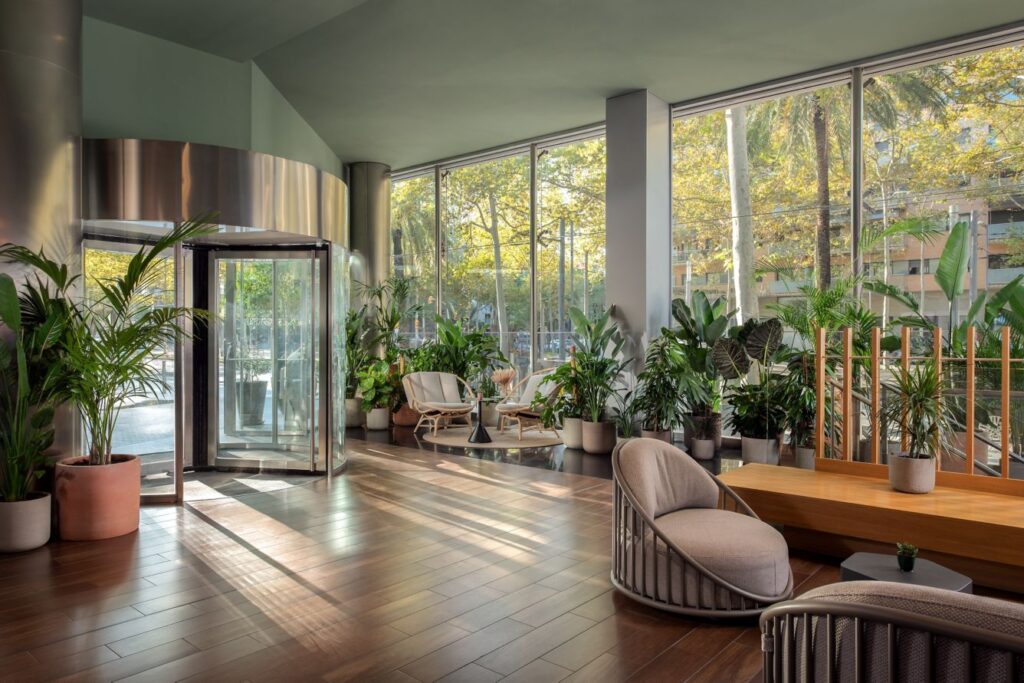
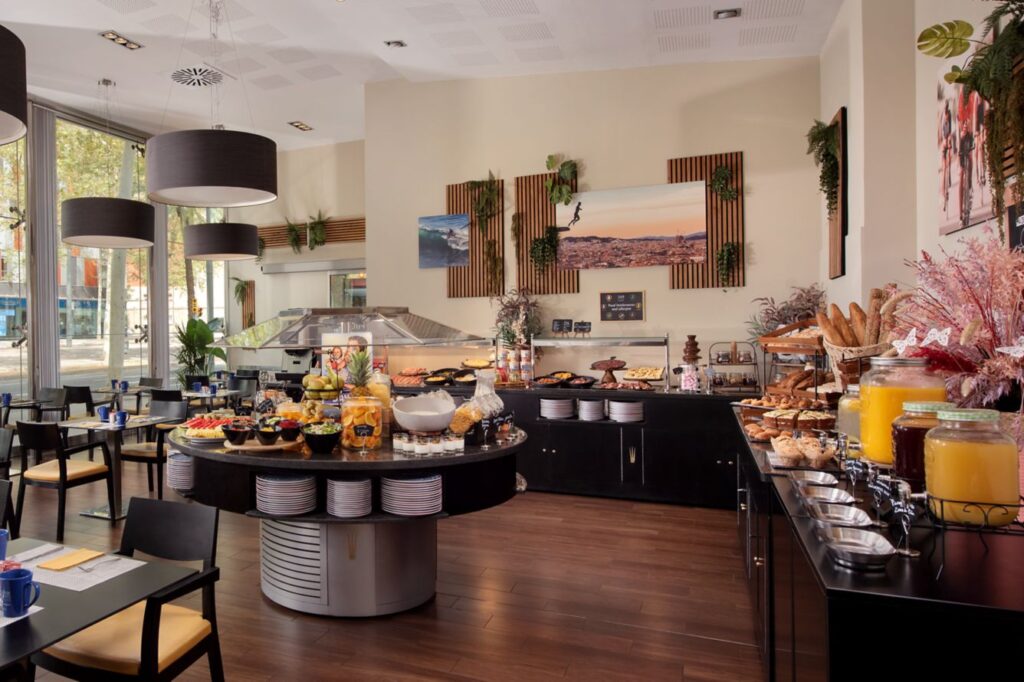
We landed on a Wednesday. Our hotel, the Four Points by Sheraton Barcelona Diagonal, became our home base. And I want to say plainly that the hotel was lovely. The staff treated us with a kind of warmth that made the jet lag easier to bear. And the breakfast alone was worth waking up for. A small practical note for anyone planning their own trip: Skip the hotel laundry service and its inflated prices. Barcelona has laundromats tucked into nearly every neighbourhood. Also, there are small markets nearby if you’ve forgotten a toothbrush or sunscreen back home. Half of travel wisdom is knowing you don’t have to solve every problem the expensive way.
For the planning itself, I used the app Wanderlog to map out our days, and I was genuinely impressed. The free version did everything we needed, from building the itinerary to tracking travel times between stops. This was a welcome discovery when we were budgeting for this trip.
The first day nobody warns you about
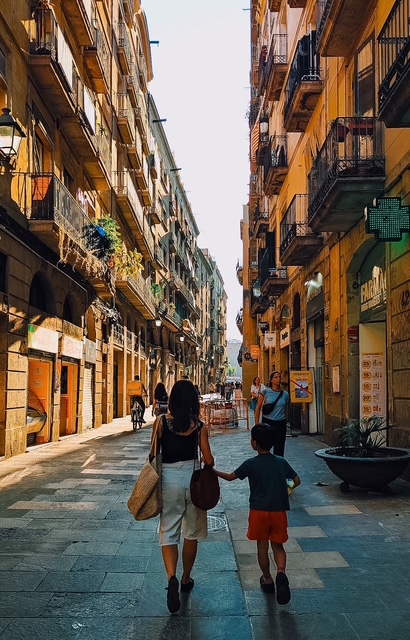
Here is something the guidebooks rarely mention: your first day in a new time zone is not really your day. It belongs to your circadian rhythm, which is still somewhere over the Atlantic. We wandered toward Passeig de Gràcia. This is Barcelona’s grand boulevard. It’s home to Gaudí’s Casa Batlló and Casa Milà. I’ll be honest with you: I thought we were too tired to appreciate any of it. But the fabulous energy of the city is there even though you think yours is not.
Zafón sets much of his Barcelona only a short walk from here, in a city he describes as carrying its own ghosts in daylight as easily as in fog. And even bleary with jet lag, I understood exactly what he meant. This was a city that seemed to hold its stories close, even to a stranger just arriving.
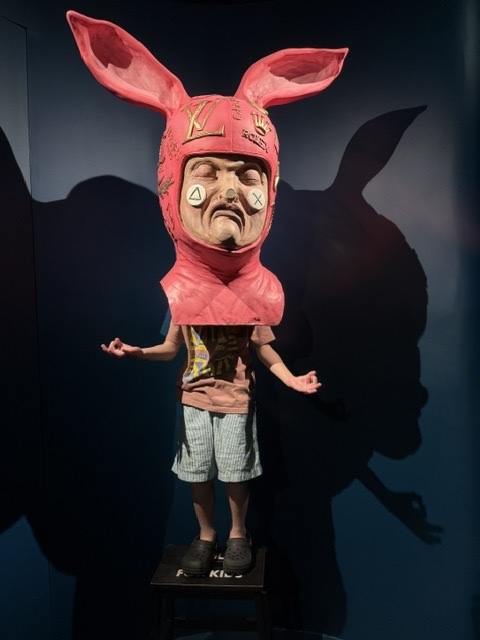
What especially saved the day was something not on our original plan at all: an interactive museum called White Rabbit. Why, you ask? Think about it:
You’re in a fog. You’re too exhausted to properly sightsee. You’re too stubborn to “waste” a day at the hotel. You need something playful and low-stakes. Not a museum or an art gallery demanding your full presence. Hey, there’s no shame in needing an easier entry point into a new place. Even ancient pilgrims built rest days into their routes for a reason. Your body has its own patterns, and a wise traveller works with them rather than against them!
We then crossed the street to Casa del Libre. This is a bookstore with a genuinely excellent English-language section. You’ll find comics, too, which delighted our son.
I couldn’t help but think of Sempere & Sons, the fictional bookshop at the heart of The Shadow of the Wind, tucked away on Carrer Santa Anna in the real Barcelona. And of the Cemetery of Forgotten Books hidden somewhere behind it, where Daniel Sempere is taken as a boy to choose one book to protect for life. Casa del Libre isn’t that shop, of course. But in the aisles, surrounded by spines in a foreign language, I felt the pull Zafón described. A bookstore is a sanctuary, a place where a city holds onto what it treasures.
From there, we walked to Mad Mad Vegan, which deserves its own paragraph entirely. We were ravenous, and I think we ordered nearly the whole menu. It was, without exaggeration, one of the best meals of the trip. What struck me most wasn’t just the flavour, but how I felt afterwards. I felt no heaviness, no desperate thirst the way I usually feel after a rich restaurant meal loaded with hidden sauces and oils. There’s something about the way Barcelona’s vegan kitchens cook. It feels clean, plant-forward, intentional. The food sits differently in the body. We still had room for dessert, which tells you everything.
Ink, architecture, and the Tour de France
Day two began the way every good day should: with a delicious breakfast, followed by something I had been looking forward to for weeks: I got a tattoo at Never I Can’t Tattoo Studio. This one, like a couple of others I carry, was inspired by a Gabriel García Márquez novel. It’s fitting to mark your body with a writer’s words. This writer grasped how memory, myth, and everyday details weave together into something bigger than each alone. Eighty euros and an hour later, I walked out with a small piece of literature stitched into my skin.
I later realized this was a fitting sister-ritual to circling streets from a different book entirely. Zafón’s and García Márquez’s words met somewhere on my own skin and in my own itinerary.
That same week, the Tour de France was about to begin, and Barcelona wore it visibly. Souvenir stands, road closures, a buzz of cyclists and fans that made the streets around Sagrada Família even more crowded than usual. As a former New Yorker, crowds don’t rattle me easily, and I’ll admit there was something almost cinematic about stumbling into someone else’s grand event while chasing our own.
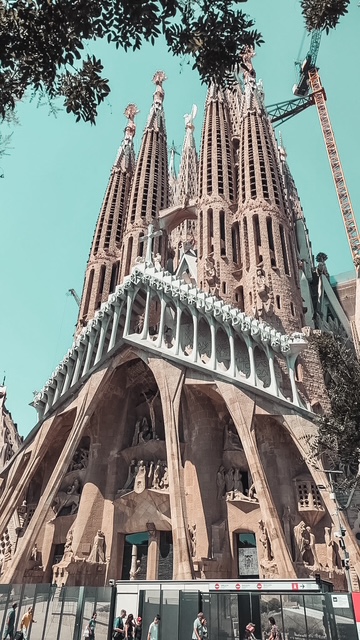
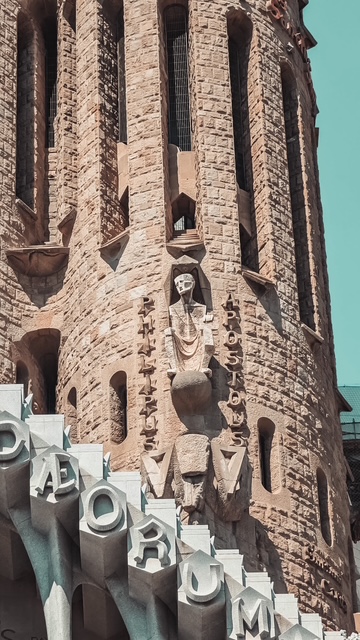
And then there was Sagrada Família itself. I don’t use the word lightly, but this tallest Catholic Church in the world is breathtaking — not only as a beautiful piece of architecture, but as a living argument. Antoni Gaudí spent over forty years of his life on this basilica, and he died before it was finished. Funded entirely by visitor admissions and donations, never by state money, it has been rising slowly for over a century!
We visited at a special time: the Tower of Jesus Christ, the tallest of the eighteen spires, had just reached 172.5 meters last February. Pope Leo XIV had inaugurated it only weeks before we arrived, in a centenary tribute marking a hundred years since Gaudí’s death. Cranes were still visible around parts of the site when we were there, quietly at work on the Glory Façade, the main entrance, which by most estimates won’t be finished for years yet. There’s something moving about standing outside a building that is, for the first time in your lifetime, nearly whole, while knowing a few final pieces are still being placed above your head. Gaudí drew from nature obsessively: his columns branch like trees, his spires echo organic forms rather than straight lines. Because he believed the natural world was already the greatest architect. Standing humbly in front of such history, light scattering across the stone like something alive, you understand that this was never meant to be merely admired. It was built to be felt.
We gave that day’s “something for everyone” slot — a small ritual I try to build into each day of any trip, one thing for me, one for our son, one for my husband — to the Design Museum of Barcelona for my husband, who works in design. It was informative for all of us, but for him especially, it was genuinely inspiring, a rare museum visit that spoke directly to his own craft.
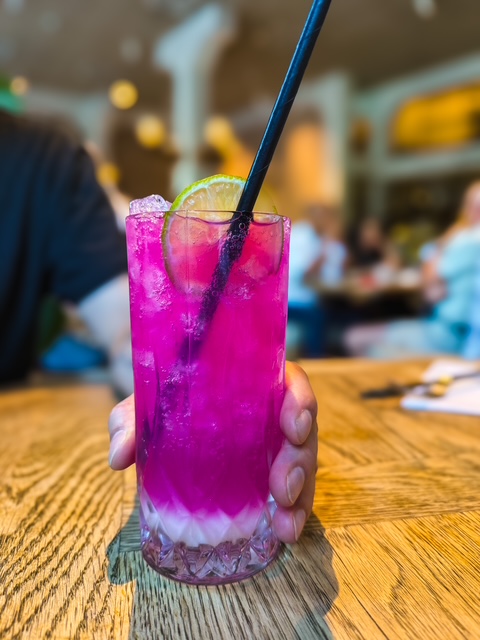
Food-wise, that day gave us Flax&Kale, a touch more polished than Mad Mad Vegan, and enjoyable food all around, though I’m not sure I’d return. Between the two, Mad Mad Vegan won my heart, and — this deserves its own moment — both places served some of the best kombucha I have ever had. I don’t drink alcohol, almost never, so kombucha has become something of my grown-up indulgence, and I say this as something of a connoisseur: Barcelona’s kombucha is unmatched. There’s a lovely parallel there, if you want to see it — a city built on fermentation and transformation, in its food as much as in its architecture, in the way Gaudí let organic forms slowly become something monumental.
Heat, humility, and the limits of a must-see
Our third day taught me something I want to pass along honestly: Park Güell, in the height of summer, tested my limits. It is beautiful — Gaudí’s mosaic-covered terraces and sculptures are worth seeing once — but I wouldn’t return in July heat again. If you go, buy tickets online in advance; the on-site reception process is genuinely difficult, and my old, faithful black fan became a survival tool rather than an accessory.
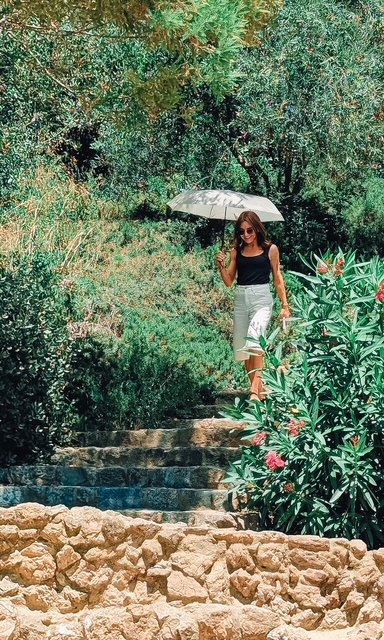
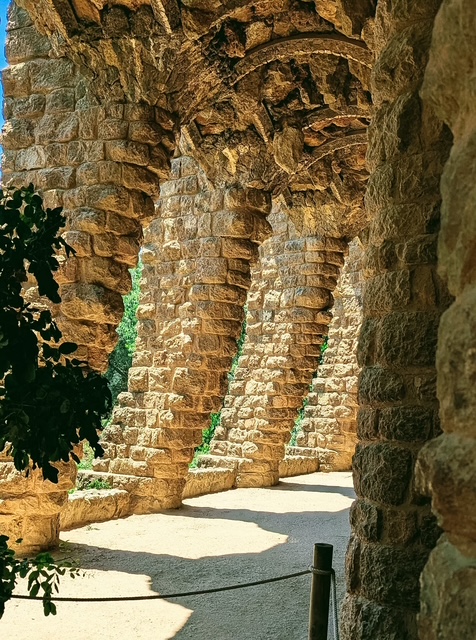
I’ll add a small, unglamorous truth here too: after standing in the heat and buying several popsicles from a small vendor right next to the park, we were given exactly one napkin each. We were not allowed any more. It’s a tiny thing, but tiny things reveal something — a business thriving on tourist exhaustion, unwilling to extend a single extra courtesy. I mention it not to dwell on it, but because I think travel writing should be honest about the moments that don’t sparkle, alongside the ones that do.
Between the heat, a rough stretch with Uber, and a string of small frustrations, that particular day had a kind of chaotic rhythm to it. I promise this was not Barcelona’s fault! It was just one of those days where things pile up one after another. We ended up skipping a planned dinner at DosManos in favour of fresh market ingredients eaten quietly back at the hotel. This turned out to be exactly the ritual we needed: simple, grounding, unhurried.
Oh, I almost forgot: Café Floh, our late-lunch stop that day, didn’t quite land for us (soggy tofu, fruit that wasn’t fresh). Though I’d still say the brunch menu looks worth trying if you’re already in the Gràcia neighbourhood. This neighbourhood is also home to Casa Comalat, a striking modernista building shaped by Gaudí’s influence. You’ll also find there the quieter, more residential charm of Carrer d’Astúries and Plaça del Sol.
Walking those narrow, winding streets, I kept thinking of the Gothic Quarter alleys Zafón sends his characters down again and again. Barcelona’s oldest neighbourhoods are built less like a grid and more like a labyrinth, the kind of place where a story could hide for decades and still be found.
What Barcelona remembers
What I keep returning to, thinking back on this trip, is how Barcelona holds two things at once. On the one hand, there’s a fierce, unfinished ambition. Think Gaudí’s cathedral still rising, stone by stone, decade after decade. On the other, there’s an equally fierce devotion to the ordinary pleasures. Think a delicious meal, a shaded plaza, a slow evening.
And underneath both, there’s the city Zafón wrote in the book I mentioned above. It’s the city that treats its own past not as something finished and shelved, but as something still being read, one generation handing the story to the next.
Barcelona is a city that seems to understand something many of us forget in our own lives. It understands that vitality doesn’t come from doing everything on the list. It comes from staying rooted enough in your own body to know when to push forward and when to rest.
Mind you, none of this makes it a “better” stop than what came next: Madrid. It only makes Barcelona a different one, asking something different of us.
One last practical note, because I think every fellow travelling parent will appreciate it: at both the Barcelona and Madrid airports, families will have a separate, faster entry line. This way, you won’t have to wait along with everyone else. A small mercy, and a welcome one.
From Barcelona, we boarded a flight to Madrid. Though next time, we’ve promised ourselves the train instead. We want to watch the Spanish countryside unfold slowly rather than from thirty thousand feet. Madrid held its own history, its own literary ghosts, and its own lessons, which I’ll be sharing in the next post.
Sign up for my newsletter to be notified the moment the Madrid blog goes live. I promise you, Madrid’s worth the wait.



Comments +