



In 2006, the neuroscientist James Coan set out to watch how a woman’s nervous system responds to a threat. He placed sixteen married women in an MRI scanner and told them they might receive a mild electric shock. Sometimes they waited alone. Sometimes an anonymous male experimenter held their hand. And sometimes their husband did.
When their husband held their hand, the brain’s threat-response systems calmed down a lot. A stranger’s hand helped too, though less. The key finding was clear: happier marriages lead to a calmer threat response.
Sit with that for a moment. The same shock, the same scanner, the same woman. What changed how her brain met the threat was who sat beside her, and how safe that relationship felt.
Coan’s explanation, social baseline theory, is one of the quietly radical ideas in modern psychology. It proposes that the human brain assumes it is surrounded by trusted, familiar people. When that assumption fails, the body has to carry the full cost of vigilance on its own.

Your nervous system is mostly listening
Hold Coan’s findings beside a fact from anatomy.. The vagus nerve, the long wandering nerve of rest and repair, is mostly a listening nerve. About 80 to 90 per cent of its fibres send signals up from the gut, heart, and lungs to the brain. The body speaks to the mind far more than the mind instructs the body.
And a third finding was published in the BMJ in 2001. Researchers asked volunteers to recite the rosary in Latin or a yogic mantra. Both slowed their breathing to about six breaths per minute. They also created strong, synchronised surges in the body’s cardiovascular rhythms. Two prayer traditions that never compared notes had arrived at the same physiological rhythm.
A relationship. A nerve. A prayer. Mind, body and soul — and at the centre of each, the nervous system, quietly deciding whether we can heal or only survive.
The missing piece
I have worked with women who have done everything. Years of diets, protocols, supplements and therapies. Their labs were optimised. Their fridges were exemplary. Yet, they still felt unwell. They were depleted, reactive, and couldn’t tap into the vitality that all their effort promised. In almost every case, the missing piece was the same. Their nervous system had never been addressed.
The approaches they tried had real merit. Most health frameworks, including integrative ones, agree on one idea. The right inputs—like food, supplements, and movement—can lead to positive outputs. These outputs include energy, hormonal balance, and overall health. That is partly true. But there is a prior condition. The body needs a receptive nervous system to accept and use inputs like food, sunlight, or love. A body locked in survival mode cannot heal. It can only survive.
What your nervous system is actually doing
The autonomic nervous system works in two main ways. One mode is sympathetic activation, which is the fight or flight response. The other is parasympathetic activation, which is for rest and digest. Stephen Porges’s polyvagal theory suggests a third state. This state is one of safety and social engagement, connected to the ventral branch of the vagus nerve. Neuroscientists still debate the theory’s anatomy, but its central observation, that felt safety and connection change how the body behaves, sits comfortably beside Coan’s findings.
In sympathetic activation, digestion is suppressed. Reproductive hormone production is deprioritised. The immune system shifts from surveillance to acute response. Stress chemistry also dampens the prefrontal cortex, the part of the brain responsible for perspective and discernment. In an emergency, all of this is adaptive. As a chronic state, it wears the body down. Yet for many women over 40, chronic sympathetic activation is simply baseline, a state inhabited so long it feels normal.
The vagus nerve is the main pathway of the parasympathetic system. It runs from the brainstem to the heart, lungs, and gut. It touches almost every organ related to the symptoms women often share with me: bloating, racing heart, shallow breath, and waking at 3 a.m. Vagal tone measures the strength and response of vagal signaling. You can estimate it using heart rate variability (HRV), and it can be changed.
If you take one thing from this article, take this: survival mode is a state, and nervous system regulation is a learnable skill.
Why this matters more after 40
The perimenopausal transition reshapes the nervous system itself. Oestrogen modulates serotonin and dopamine signalling. Progesterone helps calm you mainly through its metabolite, allopregnanolone. This substance works on GABA-A receptors, similar to many sedative drugs. As these hormones fluctuate and fall, the nervous system loses some of its chemical cushioning.
The heart records the change. In a study of over 900 people, researchers found that younger women usually have a stronger vagal influence on heart rate. However, after menopause, this influence becomes similar to that of men. Women taking oestrogen-only therapy kept more of it. A 2026 report from Withings used wearable data from 2.5 million women in 11 countries. It found that HRV decreased during the transition, while cardiovascular risk markers increased. It also found that nearly half of women do not report perimenopause until 50 or later, though measurable changes often begin in the early forties.
This is why so many women in their forties describe having “lost themselves” — and the cause is often as neurological as it is psychological. The hormonal environment that once buffered the nervous system is shifting. Without direct support for her nervous system, a woman feels always on edge. She is exhausted but can’t rest. She also feels cut off from a sense of groundedness that used to come easily.
What Ayurveda adds
Ayurveda calls this area vata, the dosha linked to air and space. It controls movement in the body, including nerve impulses. Vata naturally rises in later life, and it rises every year in late autumn and early winter, the cold, dry, windy season. When Vata is high, many women recognise the signs: anxiety, scattered thoughts, light sleep, dryness, and irregular digestion.
A woman in midlife, in November, meets vata twice. Ayurveda has provided remedies for centuries: warmth, oil, rhythm, routine, and nourishing food. These elements closely resemble a nervous system protocol.
Practices with ancient roots and modern proof
The long exhale
The exhale is an easy way to access the parasympathetic nervous system. This idea is found in many breath-focused spiritual traditions and is now backed by research. A 2023 Stanford trial found that five minutes of exhale-focused breathing boosted mood and lowered breathing rates more than the same time spent on mindfulness meditation. A simple place to begin: inhale for four counts, exhale for eight.
Cold water, warm oil
Cool water on the face triggers the diving reflex through the trigeminal nerve, slowing the heart within seconds. What your grandmother called splashing cold water on your face turns out to be applied physiology. In vata season, Ayurveda suggests keeping things brief and warming up. Abhyanga, a daily self-massage with warm sesame oil, is the classic remedy for a restless nervous system. Slow, rhythmic touch, offered by your own hands.
Sound
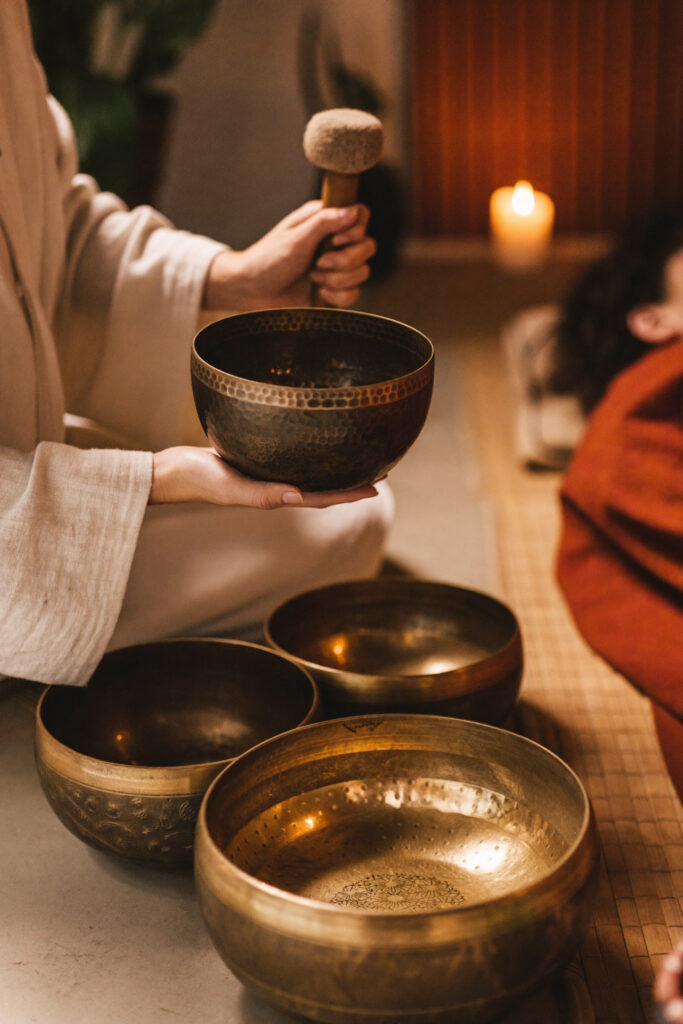
Humming lengthens the exhale and vibrates the larynx, the territory of the vagus nerve. It also does something unexpected: in one study, humming raised nasal nitric oxide fifteen-fold compared with quiet breathing.
In the Sufi tradition I follow, dhikr, the rhythmic remembrance of the divine through repeated sacred phrases, has paired sound with breath for centuries. Bernardi’s team looked at the rosary and a yogic mantra instead of dhikr. They discovered that slow, rhythmic recitation sets the breath to about six cycles per minute. This is the same pace that dhikr has always used. The mystics were working with the nervous system long before we had a name for it.
Each other
Then there is the practice we rarely call a practice. Coan’s research shows that being close to trusted people helps us regulate better. It allows our brains to share the burden of staying alert. Co-regulation is how the nervous system was designed to settle: in company, through a familiar voice, a shared rhythm, a hand.
The pattern beneath
Nervous system work shows something crucial: many women over 40 have a history of chronic activation. It was shaped by how we learned to meet the world, often in childhood, in families and cultures that asked us to be small, strong and uncomplaining. Social psychology has a great deal to say about how those patterns are learned. The encouraging corollary is that what was learned in relationship can be rewritten in relationship.
There is a feminist footnote to this science that deserves more than a footnote. Until the mid-1990s, women represented only about 17 percent of participants in studies on the body’s stress response. As a result, the fight-or-flight model many learned was mostly based on male bodies. When the UCLA psychologist Shelley Taylor and her colleagues looked again, they proposed that women under stress often reach for another response: tending to those who depend on them, and befriending others for safety. Later research suggests both sexes do this, with the pattern especially marked in women.
Tending is a strength, and it carries a cost when it becomes the only setting. The sociologist Arlie Hochschild named the work of managing other people’s feelings emotional labour, and it continues to fall disproportionately to women — at work, at home, across generations of care. A nervous system that regulates everyone else first learns to place its own needs last. For many of the women I work with, the deepest regulation begins with an unfamiliar permission: to be tended to as well.
Regulating the nervous system involves physical practice and reclamation. It’s about reclaiming the right to rest, to receive, and to live in a body that isn’t always braced for impact. For many women, this is the most radical act of healing they will ever undertake.
Join the Autumn Nervous System Reset
From 2 to 23 November, I am leading a 21-day Nervous System Reset inside The Circle, timed to the height of vata season. Three weeks of guided practice for body, mind, and soul. You’ll explore breath, sound, and seasonal Ayurvedic rhythms, along with underlying patterns. You’ll join other women, as the nervous system relaxes best in good company.
The Circle by Ivy Chan Wellness is free to join, and every member can access the reset. Join by downloading the app before 2 November and begin with us.






Comments +