



What if what you’ve been chasing all this time is what keeps your nervous system stuck?
What if more discipline, more consistency, and one last push are all backfiring? It sounds backwards, doesn’t it? But your nervous system has been trying to tell you something for years, and most of us have been too busy proving ourselves to listen.
Here’s the strange part. Your nervous system has been trying to tell you this daily. You might mistake its signals for laziness, distraction, or just a bad attitude. New research on stress, perfectionism, and the mind-body link surprised even me. Even though I spent years studying “willpower” for a living.

Real healing depends more on letting go than on pushing forward. I have spent years learning this the hard way. First as a social psychologist, studying self-presentation and motivation. Then as a woman in my forties, unlearning the belief that peace has to be earned. What I have come to understand, through research, through Sufi teaching, and through my own body, is that we have been sold a false choice. Push harder or soften. Strive or surrender. Discipline or ease. But your nervous system does not run on absolutes. It runs on rhythm. And it is quietly asking most of us to spend far more time in the surrender half of that rhythm than we currently allow.
Some days, what you need is a small, deliberate act of momentum. Other days, what you need is to stop performing and simply be witnessed, even if only by yourself. Knowing which one you need, and why, might be the most useful skill in whole-person healing.
What your nervous system is actually tracking
Let’s start with the biology, because it matters.
The field of Psychology broadly accepts, albeit with some criticism, that the human brain carries what researchers call a negativity bias. It lingers on threat and loss far more readily than it lingers on gain. Studies have found that this bias shows up as early as six months old, before a child has learned much about the world around them. That tells us something important: no one taught your brain to do this. It arrived wired that way.
The bias made sense for most of human history. A missed predator meant death. A missed berry patch just meant a hungry afternoon. So the brain evolved to remember danger in vivid detail and treat safety as background noise, easy to overlook. Some researchers see this as a basic cost-benefit calculation over millions of years. The cost of ignoring a real threat was much higher than the cost of a false alarm. So, evolution shaped a brain that leans toward fear.
The problem is that your brain never got the memo that the world changed. It still treats an unanswered email, a meal you didn’t cook “properly,” or a goal you haven’t reached yet, the same way it once treated a rustle in the grass. If not addressed, that quiet self-judgment turns into a nervous system ready for failure, even when everything is fine.
You can’t think your way out of this pattern. You retrain it, gently, through repeated proof of safety.

Small, structured proof
Your worth was never tied to what you produce. But a nervous system that has spent years bracing for disappointment often needs proof, in the body, that it is allowed to relax. That proof matters. Treat it as a doorway you keep walking through, rather than a place to set up camp.
Ten minutes towards a goal you have been avoiding. One micro-win named out loud before bed. A dreaded task broken into a piece so small it feels almost silly. These are not productivity tricks. They are how you change a pattern in real time, teaching a nervous system that expects disappointment to expect relief instead.
When fear is holding you back and a task feels heavy with dread, it is easy to spiral into overthinking. This is the moment for small, structured steps. Ten minutes. One drawer. One phone call. Proof, gently gathered, that you are safe to move forward.

When trying becomes the prison
Here is the part I had to learn the hard way. There’s a version of trying that never actually heals anyone. It’s performance, dressed up as effort.
For most of my life, I mistook effort for worth. Every conversation, every email, every casual update felt like an audition I might fail. I had studied self-presentation in graduate school. I knew that wanting to appear perfect connects to anxiety, depression, social withdrawal, and feeling not good enough. Knowing the research did not loosen its grip on me. I lived exactly as the studies described: constantly monitored, constantly defending, never at ease.
This is the shadow side of momentum-chasing. When “just do ten more minutes” quietly turns into “I am only acceptable when I am producing,” the very practice meant to heal you starts to wound you. A nervous system that once needed proof of safety now reads rest as danger, and softness as something that must be justified.
Here is where the research gets genuinely hopeful. A 2018 study in PLOS ONE looked at teenagers and adults. It found that self-compassion helps reduce the connection between perfectionism and depression. This held true across two very different age groups, using measures built for each. In plain terms: you don’t outthink a perfectionist spiral. You loosen it by building a different relationship with yourself, one rooted in being met rather than in proving yourself.

What the Sufis knew about the self
Long before psychology had terms for perfectionistic self-presentation, Sufi teachings identified this issue. They also offered a unique solution.
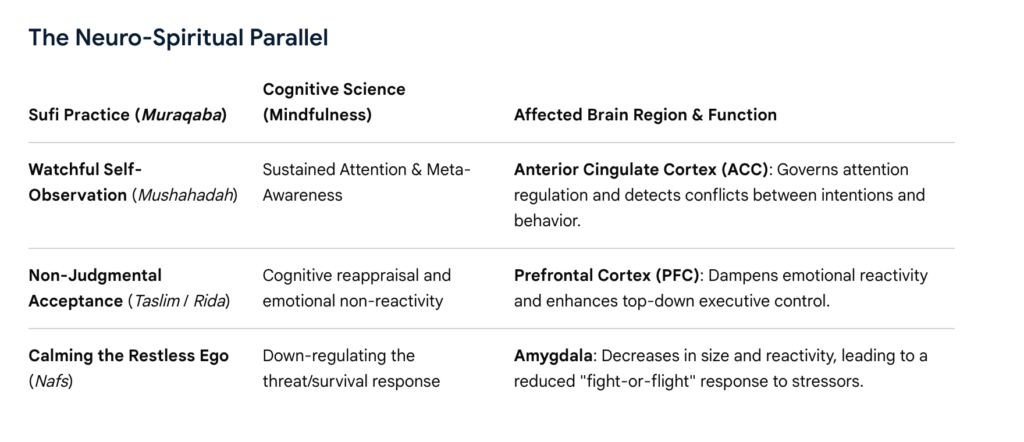
In Sufi psychology, the nafs is the ego-self: a false identity that believes it must earn worth through being perfect or in control, and that seeks its value in how others see it. Classical Sufi teaching maps the nafs through several developmental stages, moving from a fear-driven, reactive self toward what is called the nafs al-mutmainna, the calm and settled self. Sufism does not ask you to fix the nafs through more effort. It asks you to recognise it as a veil, not the truth of who you are.
This goes beyond a poetic parallel to modern psychology. It’s a genuine overlap. Muraqabah is a Sufi practice of watchful self-observation without judgment. It closely resembles what modern researchers call mindfulness. Clinical studies on mindfulness have found measurable effects on the anterior cingulate cortex, the prefrontal cortex, and the amygdala, the brain regions tied to self-awareness and threat reactivity. Sufi teachers were mapping this same inner territory more than a thousand years before neuroscience had the tools to picture it.
Rumi, the thirteenth-century Sufi mystic, wrote that the wound is the place where the light enters. Not the place we perform our way out of. The place we let ourselves be met.
This matters because so many of us, especially women navigating midlife, were taught that our worth is conditional on output. That rest must be earned. That ease is a reward for good enough performance, rather than something we are allowed simply because we exist. Reclaiming that as your birthright- the plain fact that you don’t need to constantly justify your existence- counts as some of the deepest healing work there is.

Why this hits differently as you age
If this all feels more urgent now than it did in your twenties, that is not in your head. Your body has a reason for that.
Progesterone has a naturally calming, stress-buffering effect in the body. As estrogen and progesterone fluctuate during perimenopause, their buffering effect weakens. This happens at a time filled with caregiving, work, and changing identity. Researchers found that the hypothalamus does double duty. This brain region controls reproductive hormones and the stress response. When one system is in flux, the other feels it too. Some studies tracking cortisol across the menopause transition have found levels rising as the transition progresses, tightly linked to how intense the symptoms feel.
In other words, your nervous system is carrying old patterns and doing that work with less hormonal support than it used to have. This is precisely why the old advice, push harder, do more, white-knuckle through it, tends to backfire so badly in this decade of life. Your body is asking for a gentler approach here, rather than a stronger version of the same old push.
Living inside your nervous system’s rhythm
None of this is a technique you master once and file away. Your nervous system does not heal in a straight line, and neither does the soul, so this is a rhythm you return to again and again, for the rest of your life.
Some seasons will require you to build trust in yourself, piece by piece. Other seasons will ask you to pause your building. They want you to be found just as you are—unfinished and unproven. Both are medicine. Both are true. The skill is learning, moment to moment, which one your body is actually asking for.
You don’t need to earn your ease. And you don’t need to abandon your effort.
If this resonates with you, do yourself a favour and check out The Call. It’s an unmatched system and community for women 40+ who’re tired of managing symptoms, fighting their body, and running after more willpower. Instead, you can start living in tune with your body’s true rhythm. Real-life teaching and soothing practices on the nervous system, hormones, and the soul layer of healing. Plus, a community that understands what this season of life demands from you. Tap here to learn more about The Call.
Editor’s note: The information in this article, as well as all content produced and shared by Ivy Chan Wellness, including programs, memberships, and downloadables, are provided for informational and educational purposes only. They are not a substitute for professional medical advice, diagnosis, or treatment.








Comments +